Traveling Safely on Loose Terrain: Scree, Talus, and Rockfall Movement Techniques, Spacing Rules, and Injury Avoidance
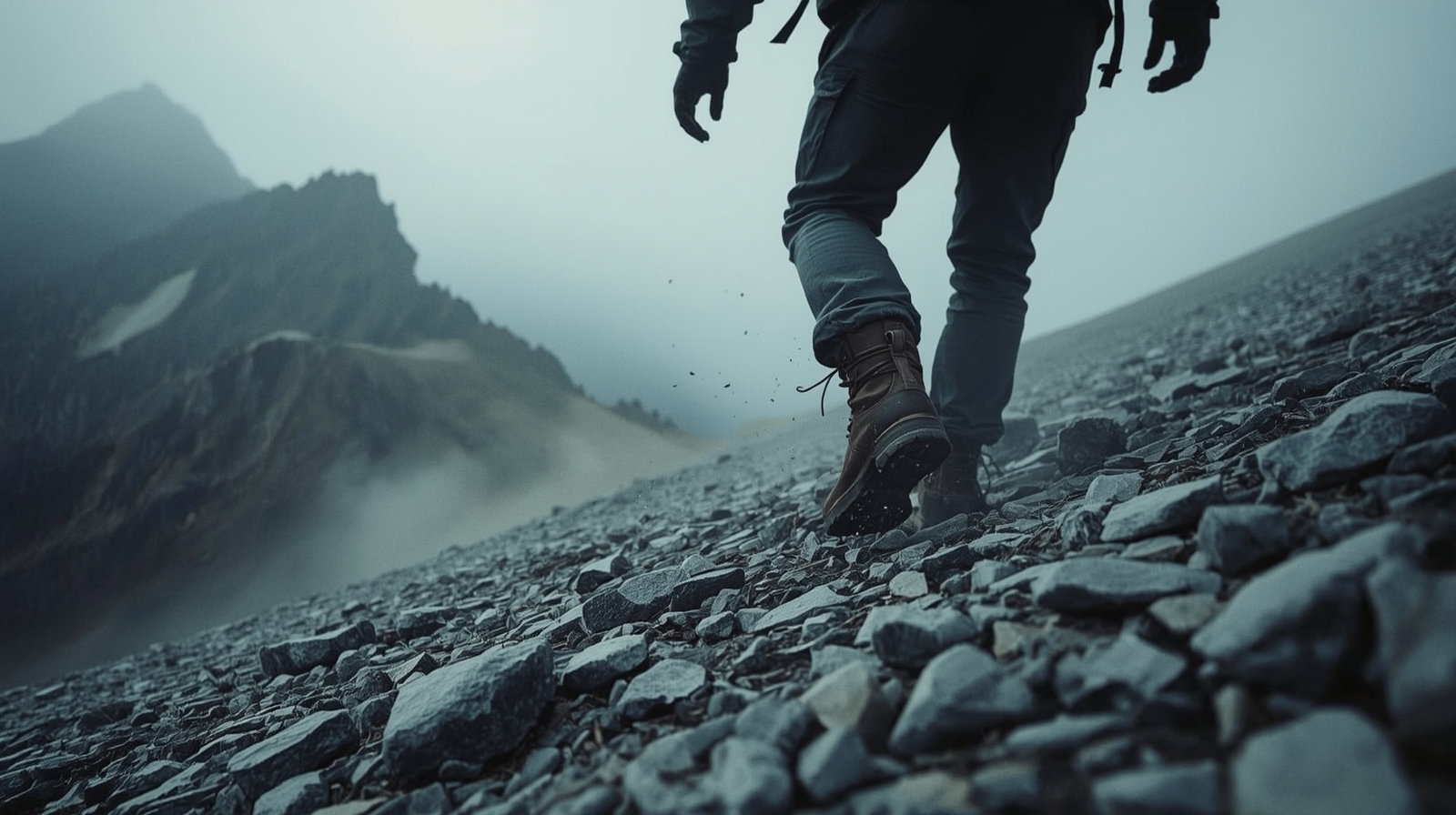
Scree, Talus, and Rockfall: What You’re Actually Walking On
Loose terrain is one of those hazards that feels “optional” until it isn’t. One minute you’re on a normal trail, and the next you’re on ball-bearing gravel, a ridge of shifting blocks, or a gully that funnels rockfall like a bowling alley.
Related Articles:
If you treat scree and talus like dirt hiking, you will eventually pay for it. The surface moves, but it moves in repeatable ways.
Your job is to manage where that movement goes, how much you trigger, and who is in the path when it happens.
Scree vs. Talus vs. Boulder Fields (and Why It Matters)
Scree is usually small, sharp rock fragments that behave like gravel. It often forms on steep slopes below cliffs and gullies.
The problem with scree is inconsistency. It can flow underfoot, and it can also hide hard, slick bedrock underneath. That combo is how you go from “stable” to “uncontrolled slide” in a single step.
Talus is larger blocks, typically fist-sized up to car-sized. Talus movement is less like sliding and more like shifting, tipping, and rolling.
Boulder fields are basically talus on hard mode: big blocks with big consequences. The hazard isn’t just the rock “moving like sand.” It’s stepping between blocks, misjudging stability, or pinning a foot where you can’t extract it quickly.
Reading Slope Angle, Runout, and “Where the Rocks Go”
Loose slopes always have a runout, the place where anything you dislodge will end up. Before you commit, trace the likely path a kicked rock would take.
Ask yourself a few direct questions:
- Does it funnel into a choke point?
- Does it bounce into the only safe ledge?
- Does it run into your team’s planned rest spot?
Angle matters because the movement mode changes with it. Lower-angle scree can be tedious but manageable.
Steeper scree can turn into a surfing slide that you cannot arrest without smashing into something. A quick field test (only if no one is below): toss a fist-sized rock and watch whether it stops, trickles, or accelerates and bounces. That’s the same behavior you’ll see when you lose traction.
Route Choice on Loose Ground: Solve the Problem Before You Step On It
Most loose-terrain incidents are route selection failures, not balance failures. If you put yourself in the wrong chute at the wrong time, perfect footwork won’t save you.
Good route choice doesn’t eliminate loose terrain. It puts you on the least consequential version of it.
Use Topo and Terrain Traps to Avoid “Rockfall Lanes”
Look for the features that concentrate debris: gullies, couloirs, and narrow chutes. These are rockfall lanes.
Even when you didn’t start the rockfall, the terrain will deliver it to you. That’s why “I didn’t touch anything” isn’t a safety plan.
When you plan, identify handrails (ridges, ribs) that keep you out of the fall line. Ribs between gullies are often more stable and give you lateral escape options if something comes down.
If you want a deeper planning framework for terrain traps and bailout routes, build it into your prep using route planning and risk assessment with topo maps. The same navigation logic that keeps you found is what keeps you from committing to a slope you can’t safely reverse.
Timing, Freeze-Thaw, and the “Natural Rockfall Schedule”
Rockfall isn’t random. It often spikes during freeze-thaw cycles and after storms.
When water freezes in cracks, it expands and pries rock loose. When it thaws, gravity does the rest.
Keep your timing realistic:
- Morning: overnight freezing may release as the sun warms the face.
- Midday: heat can loosen surface blocks and dry out “glue” (ice, moisture) holding material together.
- After rain: slopes can be lubricated, and scree can run faster than you expect.
If you need an authoritative baseline on general hiking hazard planning, the National Park Service hiking safety guidance is worth skimming. Then apply it with a loose-terrain lens: your turnaround time is not just daylight, it’s when the slope becomes a shooting gallery.
Footwork Fundamentals: Control the Slide and Control the Damage
On loose ground, your goal is not to look graceful. Your goal is to keep your center of mass over your feet and keep the slope from taking you for a ride.
Think “controlled and quiet,” not “fast and brave.” Speed hides mistakes until it’s too late.
“Quiet Feet” and Pressure Management on Talus
Use what I call quiet feet: place your foot with intent, load it gradually, and confirm stability before you commit full weight.
On talus, a fast stomp is how you tip a block or shear a smaller rock under it. You want progressive pressure, not sudden impact.
A few placement rules that work in the real world:
- Prefer flat-foot placements over toe-only.
- Match the angle of your sole to the angle of the rock.
- Avoid “teeter points” like the crest of a rounded block.
A practical drill is a micro-test every step: place the foot, apply roughly 20 percent weight, and feel for movement. If it shifts, unload and choose a new point. If it stays locked, transfer and move.
Descending Scree: Controlled Plunge vs. Side-Step (and When Not to)
Some scree slopes allow a controlled plunge step, where you let small rocks move under you while you stay upright. This only works in uniform, small scree with a clean runout and no cliff bands below.
If scree is mixed with larger rocks, side-step or zigzag to reduce speed. Keep your knees soft and your steps shorter than you think you need.
Long steps over-commit your weight and increase the chance your foot skates. If you feel yourself “starting to ride,” shorten your stride immediately and regain a stable tempo.
Do not scree-surf above hazards, above other people, or where scree can suddenly thin and expose hard rock. That transition (moving gravel to slick slab) is where falls get violent.
Trekking Poles and Handholds: Extra Contact Without False Confidence
Poles and hands can stabilize you. They can also pull you off balance if you use them like crutches instead of tools.
On loose terrain, you want redundancy, not dependency. Your feet still have to do the main job.
Pole Placement Rules That Actually Hold Up on Loose Slopes
Plant poles uphill and slightly forward, not straight out in front. If you plant too far ahead, you load the pole while your feet are still moving.
That turns the pole into a lever that yanks you downhill. It feels sudden because it is sudden.
Treat pole placements like foot placements:
- Avoid planting in moving scree where the basket will skate.
- Look for rock edges, cracks, or compacted patches.
- Re-plant often rather than “reaching” for a far placement.
Adjust length with purpose. Shorten slightly for steep uphill so you can plant without shrugging your shoulders. Lengthen slightly for descent so the poles can catch weight earlier.
Three Points of Contact and “Test Before Trust” for Handholds
When you start using hands on talus, commit to three points of contact: two feet and a hand, or two hands and a foot.
The common mistake is grabbing a loose rock and loading it like a fixed rung. On talus, nothing is fixed until you test it.
Test holds in the direction you plan to load them. Pull down and outward gently first. If it shifts, don’t negotiate with it.
Also, protect your fingers. Avoid putting fingertips into cracks between blocks where a shift can pinch or crush them. When possible, use open-hand palming on rock faces. Gloves help with abrasion, but technique prevents broken fingers.
Team Movement and Spacing Rules: Prevent Chain-Reaction Injuries
Loose terrain is where group discipline matters. One person’s mistake becomes everyone’s problem if spacing and lanes are sloppy.
Before you step onto the slope, decide how you’ll move as a team. Changing the plan halfway through usually means something already went wrong.
One-at-a-Time vs. Moving Together (Choose the Right Mode)
Use one-at-a-time movement in gullies, choke points, and any slope where a dislodged rock will funnel into the person behind.
The lead moves to an island of safety (a rib, a stable platform), calls “Safe,” and only then does the next person move.
Move together only on broad slopes where each person can maintain a separate lane and where there is no direct fall line between you. Even then, keep pace controlled and avoid bunching.
If you’re traveling with mixed ability, set the standard based on the least experienced person. That’s not politeness. It’s risk management.
Practical Spacing Distances and Simple Communication Calls
Spacing is about energy and geometry. Rocks accelerate downhill. If you’re too close, you can’t react.
A workable baseline:
- Moderate scree with separate lanes: 10-15 meters between hikers
- Steep scree or mixed talus (rocks bounce): 20-30 meters
- Gullies/under cliffs: one-at-a-time, with the waiting person tucked behind protection
Use simple calls that don’t get confused:
- “Rock!” something is moving downhill now
- “Stop!” freeze and look up-slope
- “Safe!” the mover is behind protection; next person can start
Make sure your team knows the difference between “Rock!” and casual chatter. This is not the place for vague language.
Managing Rockfall: Avoid Starting It, and Survive It When It Starts Anyway
Rockfall comes in two forms: what you trigger and what the mountain triggers. You control the first category, and you can reduce your exposure to the second.
The key is to treat every steep, loose slope as a system. Anything you knock loose has a path, a speed, and a target.
Spotting Trigger Blocks, Dinner Plates, and “Loaded” Talus
Trigger blocks are rocks sitting on smaller rocks, ready to roll when you step near them. Dinner plates are flat, loose slabs that slide when weighted.
Loaded talus is a pile where many rocks are barely in equilibrium. It often “talks” to you with tiny clicks and shifting noises as you move.
Scan for fresh scars: lighter-colored rock faces, recent debris piles, and dust lines. Those are clues the slope is active.
When you move, step on the biggest stable options available, but confirm they’re keyed in. A big rock that isn’t seated can be worse than smaller, locked pieces.
What to Do When Rockfall Starts: Escape Lines and Body Position
If rockfall starts above you, your first move is not downhill. Your first move is out of the fall line.
Get to the side of the gully or behind a rib. If you can’t escape laterally in time, get small behind the best available protection.
A few priorities that hold up under stress:
- Face the slope.
- Protect your head and neck.
- Keep eyes on the hazard if you can do so safely.
Do not sprint blindly. Loose terrain punishes panic. Fast feet on unstable ground increases the chance you fall into the rockfall path.
If you’re above other people and you dislodge something, yell “Rock!” immediately and keep eyes on it so you can update: “Rock, left!” or “Rock, center!” That directional call helps the person below move the correct way.
Gear That Actually Helps: Footwear, Helmets, Gloves, and Pack Setup
You don’t need fancy gear to move safely, but you do need the right priorities. On loose terrain, traction and protection beat comfort upgrades.
If your gear makes you clumsy or top-heavy, it’s not helping. It’s just expensive ballast.
Footwear Tradeoffs on Talus and Scree (With a Reality Check)
Footwear choice is a compromise between edging, ankle support, and sensitivity. People argue boots vs. trail shoes like it’s religion, but it’s terrain-specific.
Here’s a practical comparison:
| Footwear type | Strength on talus | Weakness on scree | Good use case |
|---|---|---|---|
| Trail runners | Great sensitivity, fast footwork | Can skate on loose gravel, low protection | Dry talus hopping with light packs |
| Mid hiking boots | Better torsional support, toe protection | Heavier, can encourage sloppy steps | Mixed talus/scree with moderate loads |
| Approach shoes | Excellent edging on rock, sticky rubber | Not much ankle support, can clog with grit | Ridge scrambles with short scree crossings |
| Mountaineering boots | Rigid platform, strong protection | Overkill and fatiguing on long hikes | Alpine routes with snow/rock mix |
If your ankles roll easily, support matters, but it won’t replace technique. Most ankle injuries happen because the foot lands on a moving rock with weight already committed.
Helmets, Eye Protection, and the Pack Details People Forget
A helmet is not just for climbers. If you’re traveling under cliffs, in a gully, or below other people, head protection is one of the few gear choices that can prevent a catastrophic outcome.
Eye protection matters more than most hikers admit. A small rock fragment to the face can end the day instantly, and it can turn a simple evacuation into a true emergency.
Pack setup is the other quiet factor. If your load rides high and sloppy, it shifts your center of gravity and amplifies every wobble.
Use this quick pack check before you commit to loose terrain:
- Tighten compression straps so the load doesn’t sway.
- Keep heavy items close to your spine and mid-back (not hanging off the outside).
- Secure dangling gear (trekking pole tips, bottles, tools) that can snag and spin you.
- Loosen shoulder straps slightly on steep descents so you can move your torso and breathe.
The goal is simple: you control the pack, not the other way around.