Night Camp Control Procedures: Challenge/Password, Sectors of Fire, Noise Discipline, and Preventing Blue-on-Blue Incidents
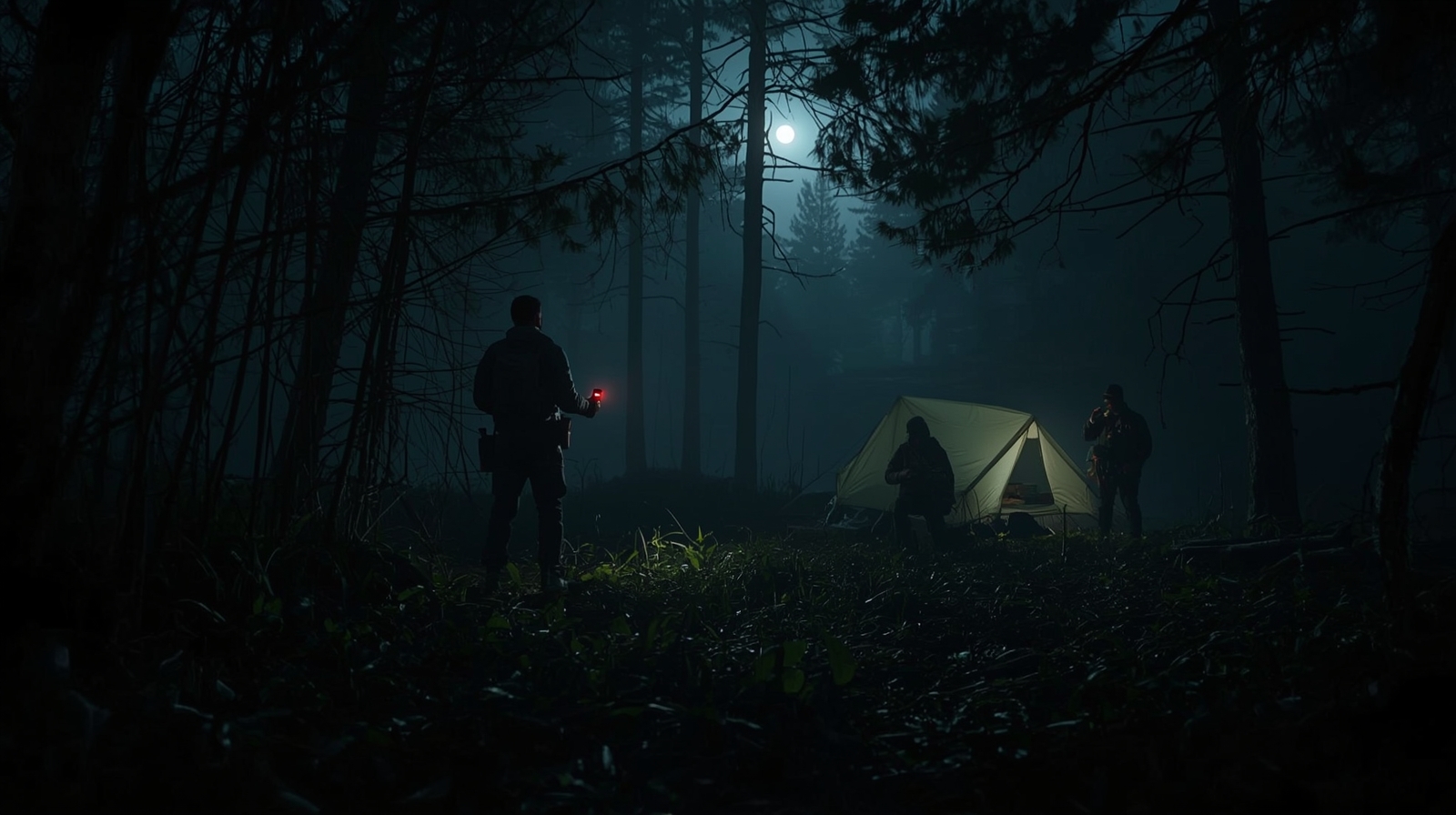
Night camp control starts before darkness and before stress
A controlled night camp isn’t about turning your campsite into a fortress. It’s about reducing ambiguity when everyone’s senses are degraded. Darkness, fatigue, cold, and unfamiliar terrain all combine to make simple mistakes more likely.
Your job is to build procedures that keep people from surprising each other. Just as important, you want predictable responses: “If X happens, we do Y.” That predictability is what keeps a small problem from turning into a domino effect.
At night, you don’t rise to the occasion. You default to your training and habits. If your camp routines are informal, you’ll get informal results — people wandering off without telling anyone, headlamps flashing through tents, and confused shouting when a branch snaps. Procedures exist so that panic doesn’t fill the vacuum.
Control measures vs. security theater
There’s a meaningful difference between the two. One reduces risk. The other just looks tactical.
- Defining who can move
- Defining where they can move
- A clear way to announce movement
- A repeatable process to verify identity
- Predictable, rehearsed responses to events
- Random yelling across camp
- Uncoordinated flashlight scanning
- Everyone holding a weapon with no assigned arcs
- Complex systems that collapse under fatigue
- Procedures nobody rehearsed before dark
Why blue-on-blue is the real night threat
In civilian camping, your most likely “enemy” is confusion. A family member comes back from the trees and gets hit with a high-powered light. A hunting partner returns late and is mistaken for a stranger. Someone stumbles into a sector where another person is watching and gets startled.
Blue-on-blue incidents don’t require firearms. They can be a dog bite, bear spray in the wrong direction, a fall after someone yells, or an accidental knife cut while scrambling.
Your goal is to eliminate surprise movement and make identification boring. Boring is safe. The procedures below exist to make every movement predictable — so that anything outside the pattern immediately stands out.
The four pillars of night camp control
A night camp control plan is easiest to remember when it has four pillars. Build all four before dark. Brief them once. Enforce them quietly.
Camp layout decisions that make night control easier
Before you talk passwords and sectors, your camp layout needs to support control. A bad layout creates crossing foot traffic, blind spots, and accidental backlighting. A good layout funnels movement along predictable routes.
Site selection matters too. If you build camp in a bowl, sound carries and you’ll misjudge distance. If you pitch under dead branches, you’ll spend the night reacting to every crack and thud. For the fundamentals of picking a defensible, comfortable site, use this guide on shelter site selection and camp layout. Then layer the night control measures on top.
Establish a clear “inside the camp” and “outside the camp” boundary
You don’t need a fence line to create a perimeter. You need a shared mental map. Use natural features (tree line, creek edge, rock band) or simple markers (tape, cord, reflective points kept covered) to define what counts as “inside.” The key is that everyone agrees on it before dark.
Then set two movement rules that don’t change:
- Nobody exits without telling the watch or the designated point person — no exceptions for “just a quick trip.”
- Anybody returning stops at the defined entry point and announces themselves using the challenge procedure — even if they’ve been gone for two minutes.
The entry point is not a suggestion. If someone returns from a random angle through the brush instead of using the entry route, that’s a training failure. Correct it quietly the first time and firmly the second. The route exists so the watch has one predictable place to focus.
Create a single entry route for night movement
Multiple entry points feel convenient until you’re trying to identify a person moving through brush at 0200. Pick one primary night entry and one emergency alternate. Clear the route enough that people won’t trip, but don’t turn it into a runway that advertises your location.
If you have a large group, use a “dogleg” entry path. The final approach turns once before reaching tents. That way, a headlamp (if accidentally used) doesn’t wash directly through everyone’s shelter.
Place “quiet needs” away from “sleep needs”
Bathroom routes, cooking, and water runs are where people make noise. Don’t route those paths through sleeping areas. If the latrine area is 50–100 meters out, the return path should approach camp from the same direction every time. Consistency reduces surprises.
Layout checklist — set before dark:
— Perimeter agreed and communicated to all group members
— One primary entry point, one emergency alternate
— Latrine/water routes do not pass through sleep area
— “Dogleg” turn on final approach to prevent headlamp bleed
— Watch position has clear line-of-sight to entry point
Challenge and password systems that work for real humans
The challenge/password is not about sounding cool. It’s a low-light identification tool that prevents someone from walking into camp and being misread. It also prevents friendly movement from being mistaken as a threat. Keep it simple, keep it standardized, and keep it current. The more complicated you make it, the more likely tired people will fail it under stress.
Choosing a password people can remember under stress
A good password is short, distinct, and not easily guessed from context. Avoid anything tied to your location, your group name, or your destination. Avoid inside jokes that new people won’t remember — at night, forgetfulness looks like suspicious behavior.
A two-part system is usually enough: a Challenge word spoken by the watch, and a Password response. Example: Challenge “Maple.” Password “Ridge.”
Crisp consonants, not slurred vowels. If you’re in a winter camp, avoid words that get garbled when you’re shivering (words ending in -ing, -ow, -oh are easily confused). Pick words that sound distinct even through chattering teeth and a balaclava. Test your password out loud before dark.
A challenge script that reduces mistakes
Most failures happen because people improvise. Fix that with a script everyone rehearses once before dark. The “face away” step matters — it reduces the chance of a sudden turn that startles the watch, and prevents bright headlamps from flashing into eyes if someone forgets and clicks one on.
When and how to change the password
If anyone outside your group could have heard it — near a trailhead, near other campers, or after it was yelled — change it immediately. If someone gets it wrong once due to confusion, change it anyway. It’s not punishment; it’s clarity.
Password rules — quick reference:
— One challenge, one password, whole camp uses the same pair
— Establish it before dark and confirm everyone can repeat it
— Valid for tonight only — update if you’re staying put
— Change it immediately if overheard or if confusion occurs
— Never yell it repeatedly across camp to “remind” people
— The U.S. Army’s doctrinal publications reinforce simple, repeatable night controls — see Army Publishing Directorate
Sectors of observation and “sectors of fire” without unsafe overlap
“Sectors of fire” is a military term often misunderstood in civilian contexts. If your group isn’t armed, treat it as sectors of observation: who is watching what direction, what landmarks define the edges, and where you do not want people moving. If firearms are present — hunting camp, predator defense, or a lawful defensive posture — sectors become even more critical. Your priority is preventing a muzzle from tracking a friendly.
Assigning sectors using terrain and reference points
A sector should be defined by two visible reference points: “From the big boulder at 11 o’clock to the dead snag at 2 o’clock.” At night, clock directions work better than compass degrees for most people. Keep sectors wide enough that a watch isn’t spinning constantly. Keep them narrow enough that responsibility is clear.
Two people can cover 360 degrees in a small camp if you define “front” and “rear” and use terrain as a natural boundary. The objective is not symmetry — it’s preventing everyone from watching the same direction while the obvious approach goes unwatched.
The overlap rule that prevents blue-on-blue
Overlapping fields of observation are fine. Overlapping fields of fire are where accidents happen. If firearms are present, make this a hard rule with no exceptions:
No one points a weapon into another person’s sector without verbal coordination. Your sectors must be arranged so that tents and common movement routes are not downrange of anyone’s likely engagement line. If you can’t arrange that with your current camp layout — reposition tents, reposition the watch point, or both. The layout serves the safety, not the other way around.
Sector cards — a simple table your group can follow
Write sectors down. Memory gets fuzzy at night, especially for someone who’s half-awake coming off sleep rotation. Use a small note card or a dimmed phone note that includes reference points, danger areas, and expected friendly movement routes.
| Role | Primary Responsibility | Sector Reference Points | No-Go Movement Area |
|---|---|---|---|
| Watch A | Entry route control | Creek bend → tall pine | Behind tents |
| Watch B | Rear observation | Rock outcrop → ridge saddle | Toward latrine path |
| Sleeper 1 | On-call support | N/A until woken | Stay inside perimeter |
| Sleeper 2 | On-call support | N/A until woken | Stay inside perimeter |
Noise discipline that reduces false alarms and preserves sleep
Noise discipline is not “be silent all night.” It’s controlling unnecessary noise so meaningful sounds stand out. The less your camp clatters and chats after dark, the more you can trust what you hear. It also keeps you from advertising your exact location to every other group in the basin.
Sound travels farther at night — especially across water or open ground. If you’ve ever heard a conversation from an absurd distance in the dark, you already know this is real and not an exaggeration.
Establish a “quiet hours” standard and enforce it politely
Pick a time — usually after last light — when you shift from normal camp life to quiet hours. That means: no loud food prep, no clanking pots, no tent-to-tent yelling. Use a low voice and close distance before you speak. The awkwardness lasts five minutes. Then everyone sleeps better for the rest of the night.
The biggest benefit is simple: when you do hear something outside the perimeter, it’s not competing with constant camp noise. Signal-to-noise ratio is everything.
Control your signature — the common offenders
The loudest sounds in most camps are avoidable. Before dark, stage your essentials so you don’t have to rummage at 0100.
Put your headlamp, water, and layers in the same place every night so you don’t have to search for them. If you’re in cold conditions, this pairs well with a disciplined sleep setup — the details are in cold-weather sleep systems.
“Noise makers” used the right way
If you use perimeter noise makers — trip lines with small items, improvised alerts — the goal is not a huge racket. The goal is a distinctive, unnatural sound that wakes you reliably. That detail is covered in depth in low-tech early warning perimeters for camps.
Place noise makers where you want to detect movement — not where your own people will constantly set them off. False alarms train your group to ignore the alarm. A perimeter alert that goes off three times from the wind and once from a person becomes indistinguishable. Design out the false positives first.
Light discipline and night vision: stop blinding your own team
Light discipline is one of the fastest ways to reduce confusion at night. A single white headlamp blast can destroy night vision for minutes. It also becomes an accidental “signal flare” to anyone else in the area. You don’t need to ban lights — you need rules for when, where, and how lights are used.
Use layered light options instead of one setting
Set your headlamp before dark so you aren’t fumbling through modes when you’re half-asleep. The discipline is simple — three tiers, with a clear escalation rule between them.
Angle lights down toward your feet or hands. Avoid face-level beams that hit other people in the eyes. If you’re moving in camp, keep the beam tight and low. If you’re scanning outside camp, coordinate with the watch so you don’t light up a returning friendly at the entry point.
The white light callout rule: Before activating a bright white light, say its purpose out loud. “White light, medical.” “White light, gear check.” That one sentence prevents surprise, gives everyone a second to look away, and stops the watch from reacting to a sudden flash as a threat. Build this habit before dark — it costs nothing and prevents a lot.
- Black Diamond Spot 400
- Petzl Actik Core
- Fenix HM65R
- Streamlight ProTac
- Nitecore MH12SE
- SureFire G2X
- Nightfox Swift
- Solomark NV900
- Rexing B1 Gen 2
- Mcardinal SuperAlarm
- Guardline GL2000
- Dakota Alert MURS
- TOUGH-GRID reflective
- Paracord Planet 550
- Atwood Rope MFG
- Carhartt watch cap
- Under Armour tactical balaclava
- Rothco military watch cap
- Cyalume SnapLight
- IR chem lights (12hr)
- Adventure Medical strobe
- Rite in the Rain 980T
- Mil-Spec field book
- Fisher Space Pen + paper