Low-Tech Early Warning Perimeters for Camps: Trip Lines, Noise Makers, and Sector Assignments (Without Electronics)
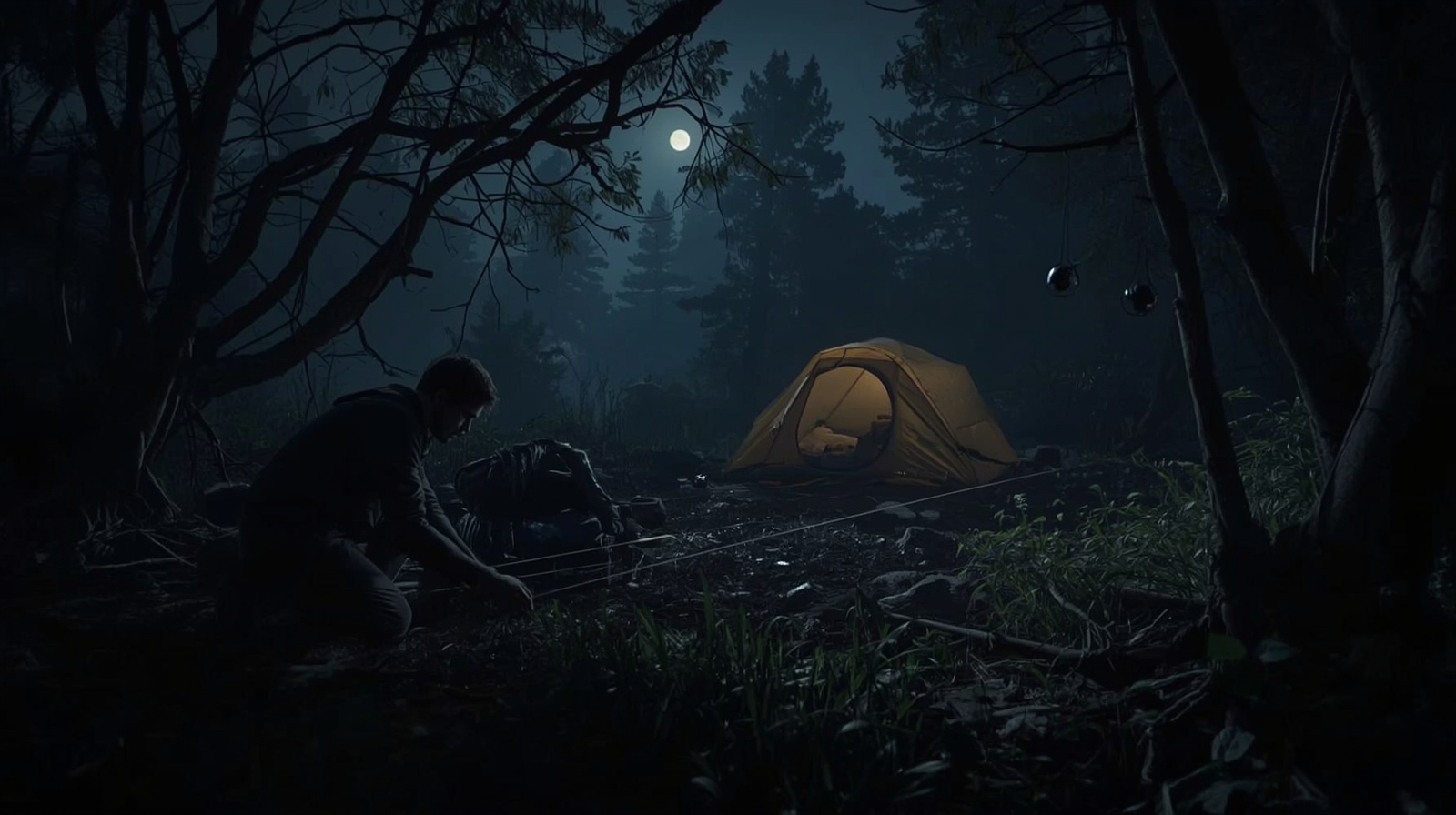
Why Low-Tech Early Warning Perimeters Still Matter
A camp perimeter is less about “defending” and more about buying time. In the field, time is what lets you wake up, get oriented, and make smart decisions instead of panicked ones. Low-tech systems do that quietly and reliably, without batteries, signal, or screens.
Related Articles:
If you’ve ever been startled awake by footsteps outside your shelter, you already understand the problem. At night, your brain is slower, your fine motor skills are worse, and you’re working off incomplete information. An early warning perimeter creates a buffer zone, so the first surprise is a sound or a signal you set up-not a person standing over you.
The real purpose: time, information, and control
Your perimeter should do three things:
- Detect movement early
- Tell you roughly where it happened
- Help you control what happens next
That’s it. You’re not building a booby trap, and you’re not trying to “win” an engagement with fishing line.
Think of it like a smoke alarm. It doesn’t stop the fire, but it gives you the seconds you need to act. A well-placed trip line with a noise maker can wake the group, prompt a quiet headcount, and let you move to a pre-planned position.
When electronics fail, the basics keep working
Electronics are great until they’re not. Batteries die in cold weather, cheap motion sensors false alarm in wind, and bright screens ruin your night vision. Even radios create noise and tempt you into constant chatter.
Low-tech is dependable because it’s simple. Cordage, cans, rocks, sticks, and basic discipline don’t care about temperature or reception. If you want a solid baseline for preparedness thinking, Ready.gov lays out the principle of planning for disruptions and building layered options: Ready.gov.
Quick reference box A good low-tech perimeter buys time, identifies a direction, and keeps your own people from getting surprised.
Next, you need to set yourself up for success by using terrain and camp layout to your advantage.
Terrain and Camp Layout Basics Before You Hang a Line
Before you touch cordage, you need a plan for the ground you’re living on. Perimeters fail most often because people build them around where they wish the terrain was, not how it actually is. Start with what a person can realistically approach, where they’d prefer to approach, and what you can actually observe.
In training, we’d talk about “avenues of approach” and “dead space.” You don’t need the jargon, but you do need the concept. People (and animals) usually take the easiest route, and they’ll use cover and concealment if it’s available.
Picking a site that makes warning systems easier
If you can choose your camp, choose it with security in mind. Avoid low spots and bowls where sound pools and visibility is poor. Also avoid setting up right next to a trail, a creek crossing, or a natural choke point unless you have a specific reason.
Look for a position with at least one clear view and natural barriers in other directions, such as:
- Thick brush
- Steep slopes
- Downed timber
- Boulders
- Water
Natural barriers reduce how much perimeter you have to “build.” The less line you need, the fewer failure points you create.
Mapping likely approach routes in daylight
Do a slow walk around your proposed camp in daylight. Stand where an outsider would stand and look back in. Then ask yourself two simple questions:
- “Where would I step to stay quiet?”
- “Where would I step to stay hidden?”
Mark likely routes with plain references: that obvious game trail, the gap in the brush, the dry creek bed, the gentle ridge line. Those are your priority lanes for early warning.
If you have limited materials, cover the most likely routes first. A perfect circle that’s too thin to work is worse than a partial perimeter that’s solid.
Once you’ve picked your lanes, the next step is choosing materials that won’t fail at 0200 when you’re half awake.
Choosing Cordage and Hardware That Won’t Fail at Night
The best warning system is the one that doesn’t break during the first gust of wind or the first curious raccoon. Most perimeter problems are gear problems: wrong line, wrong knots, wrong tension, and weak anchor points.
You don’t need fancy equipment, but you do need reliable materials and a repeatable setup. The goal is consistent performance, not improvisation that changes every night.
Cordage options: visibility, strength, and handling
Here’s a practical comparison of common cordage types for trip lines and noise-maker rigs:
| Cordage type | Pros | Cons | Best use |
|---|---|---|---|
| Bank line (tarred twine) | Low shine, good knots, weather resistant | Lower strength than paracord | Quiet trip lines, small rigs |
| 550 paracord | Strong, versatile, easy to tie | Can be bulky and visible | Anchor lines, main runs |
| Monofilament fishing line | Hard to see, lightweight | Cuts hands, weak knots, dangerous if misused | Avoid for human trip lines |
| Natural cord (jute/sisal) | Quiet, blends in | Weak when wet, rots | Short-term, dry conditions |
If you take one lesson from experience, let it be this: avoid monofilament for human detection lines. It’s not just unreliable. It can injure people and animals, and it’s difficult to see during recovery.
Use something you can find and remove later, even in bad light.
Anchors, connectors, and knots that stay put
Your system is only as good as the anchors. Small saplings and dead branches snap under tension, especially in wind. Use live trees (where legal), stout stakes, or heavy rocks with a wrap that won’t slip.
For knots, keep it simple and consistent:
- Bowline for fixed loops
- Two half-hitches for quick securing
- Taut-line hitch or trucker’s hitch when you need adjustable tension
If you can’t tie it in the dark with cold hands, it’s not a good knot for your perimeter.
Checklist – Use low-shine cordage (bank line or muted paracord) – Anchor to solid points that won’t sway excessively – Tie knots you can undo after tension and moisture – Carry a small blade for safe, controlled teardown
With cordage and anchors squared away, you can start building trip lines that signal clearly without creating unnecessary risk.
Building Simple Trip Lines That Signal Without Trapping
Trip lines should alert you, not harm someone. In disciplined field environments, the emphasis is always on control and accountability. You should be able to explain what you built, why you built it, and how you’ll remove it.
A good trip line is a detection trigger. The “effect” is a noise, a movement of a marker, or a disturbance you can confirm with light when you choose to use it.
Placement: knee height is not your default
A common mistake is stringing line at shin or knee height across open ground. That’s where people trip hard, and it’s also where wildlife triggers it constantly.
Instead, think in terms of contact points a moving body is likely to hit. For human detection, waist height across a narrow approach lane can be more effective and safer than a low line.
In brushy areas, a mid-level line catches gear and clothing, creates more noise, and is less likely to cause a fall. In animal-heavy areas, set your line higher and use narrower “gates” to channel movement.
Safe triggers: breakaway links and controlled tension
Build in a weak link so the system gives way rather than entangling. A short piece of lighter twine, a thin rubber band, or a simple slip loop can serve as a breakaway.
The point is straightforward: when something hits the line, the noise maker activates, and the line releases. Keep tension moderate. Over-tensioned lines snap or pull anchors loose, and they’re more likely to injure.
A practical method is to tension until the line is straight but still deflects several inches with a light push.
Quick reference box Trip lines work best when they cover narrow approach lanes, use breakaway links, and trigger a clear noise or visible signal.
Once your “switch” works, your next job is making sure the “alarm” is loud enough to matter and consistent enough to trust.
Noise Makers That Actually Work: Cans, Bells, and Natural Materials
Your noise maker is the alarm. The trip line is just the switch. If the noise is too quiet, too unreliable, or always going off in the wind, you’ll stop trusting it.
Once you stop trusting it, you stop reacting. That’s when the system becomes decoration.
Aim for loud, distinctive, and repeatable. You want a sound that is clearly not normal night noise.
Proven options: metal-on-metal beats clever ideas
The simplest reliable setup is still one of the best: a few metal cans or metal cups with small rocks inside, hung so they collide when pulled. Bells work too, but they can be inconsistent depending on how they’re struck.
A practical configuration is a “cluster” hung from a branch or a crossbar:
- Three cans
- Two small pebbles in each can
- Spaced so a tug swings them into each other
The sound is sharp and carries. It also tends to stand out compared to wind in leaves.
Natural and improvised noise makers
If you’re improvising, focus on hard materials that resonate. Dry seed pods, stacked sticks, and suspended rocks can work, but you need to test them from your sleeping position.
If you can’t hear it clearly while lying down, it’s not an alarm. One effective low-profile option is a clacker line: two flat pieces of wood or bone hung close together so a pull makes them strike.
Whatever you choose, build one test rig and deliberately trigger it 10 times. If it works 10/10, build more.
| Noise maker | Wind resistance | Loudness | Build time | Notes |
|---|---|---|---|---|
| Cans with rocks | Medium | High | Low | Best all-around |
| Small bells | Medium | Medium | Low | Good backup |
| Stick clackers | High | Medium | Medium | Quiet woods may need more volume |
| Rocks in a bag | High | Medium | Low | Needs a hard impact surface |
With detection and alerting handled, you now need a human plan-who watches what, and what happens after a trigger.
Sector Assignments and Night Observations Without Gadgets
A perimeter is only as useful as your response plan. When something trips a line, you need to know who looks where, who stays put, and who controls light and noise.
Otherwise you’ll have three people moving at once and nobody actually observing. In military terms, this is basic sector responsibility. For a camp, it’s simply disciplined teamwork.
Assigning sectors: simple, specific, and repeatable
Stand in the center of camp and divide the world into slices. You can do it with terrain references:
- “From the big pine to the creek”
- “From the boulder to the old fence line”
Assign each person a sector, even if it’s just a family group. The key is clarity.
If a noise maker goes off on the creek side, the creek-side person observes and reports. Everyone else stays quiet, stays low, and listens. Your goal is to reduce confusion, not create a crowd at the same angle.
Observation posture and noise discipline at night
At night, your eyes need time. If you blast a headlamp immediately, you destroy your own night vision and advertise your location. Start with listening.
Count a few seconds. Identify direction and distance as best you can.
If you need light, use it deliberately: a quick flash to confirm a shape, then off. Avoid talking over each other. One person speaks at a time, low volume, using short phrases such as:
- “Contact, north line.”
- “Animal, likely deer.”
- “Unclear, hold.”
The calmer your process, the more you’ll trust it. For general backcountry risk context, the National Park Service offers practical safety guidance that reinforces planning, awareness, and conservative decisions: NPS Safety.
Once roles are clear, you can strengthen reliability by building depth-so one failure doesn’t collapse the whole setup.
Layering Your Perimeter: Inner, Middle, and Outer Rings
One line is easy to defeat accidentally. Wind knocks it down, a raccoon triggers it, or your own people forget it’s there. Layering is how you build reliability without making the setup overly complex.
Think in rings:
- An outer detection layer
- A middle confirmation layer
- An inner control layer that keeps your own movement organized
The outer ring: early detection on likely approaches
Your outer ring doesn’t have to be a full circle. It should cover the most likely approach lanes you identified in daylight. Keep it far enough out that if it triggers, you have time to wake, orient, and decide.
As a rule of thumb for small camps, 25-50 yards can be workable if terrain allows. In dense woods, that might be 10-20 yards because visibility and sound travel are different.
Prioritize where people can actually walk. You’re not trying to detect someone crawling through thorns if no one would do that.
The middle and inner rings: confirmation and control
The middle ring is where you put your most reliable, least false-alarm-prone devices. Use fewer lines, better anchors, and louder noise makers. This is the ring that confirms something is actually entering your space.
The inner ring isn’t about detection as much as movement control. It can be as simple as a clearly understood “no-go” boundary at night and a designated latrine path.
The fewer random movements inside camp, the easier it is to interpret a sound outside camp.
Quick reference box Layering reduces false alarms because you stop reacting to every single ping and start reacting to patterns: outer alert, middle confirmation, inner control.
With layers in place, the final piece is preventing your own people from triggering your system-or reacting to each other like strangers.
Drills, Passwords, and Challenge Procedures to Prevent Friendly Fire
The biggest risk in a stressed camp is your own people startling each other. If someone gets up to check a noise and walks into a trip line, you’ve created the exact chaos you were trying to prevent.
You don’t need heavy tactics. You need a simple routine everyone follows, every time.
Simple movement control: routes, permissions, and timing
Establish two things before dark:
- The routes people are allowed to use
- The rule for leaving shelter
For example: “After dark, nobody leaves without waking the point person.” That one rule eliminates most friendly surprises.
Mark internal paths with subtle, non-electronic cues that you can still see or feel at night. Keep them simple and consistent so a half-awake person doesn’t make a wrong turn.
Use the same plan every night you’re in the same location. Repetition is what turns a good idea into a reliable habit.
A basic challenge-and-response that stays calm
If you’re camping with a group, agree on a low-key challenge procedure. It doesn’t need to be dramatic. It just needs to be consistent and quiet.
A practical option is:
- One person calls a single word at low volume (the challenge)
- The moving person answers with the agreed response
- Movement continues only after the response is correct
Keep it short, and don’t use anything you’d yell in normal conversation. The purpose is positive identification, not intimidation.