Hypothermia in the Field: Early Recognition, Afterdrop Risks, Rewarming Priorities, and Improvised Warming Techniques
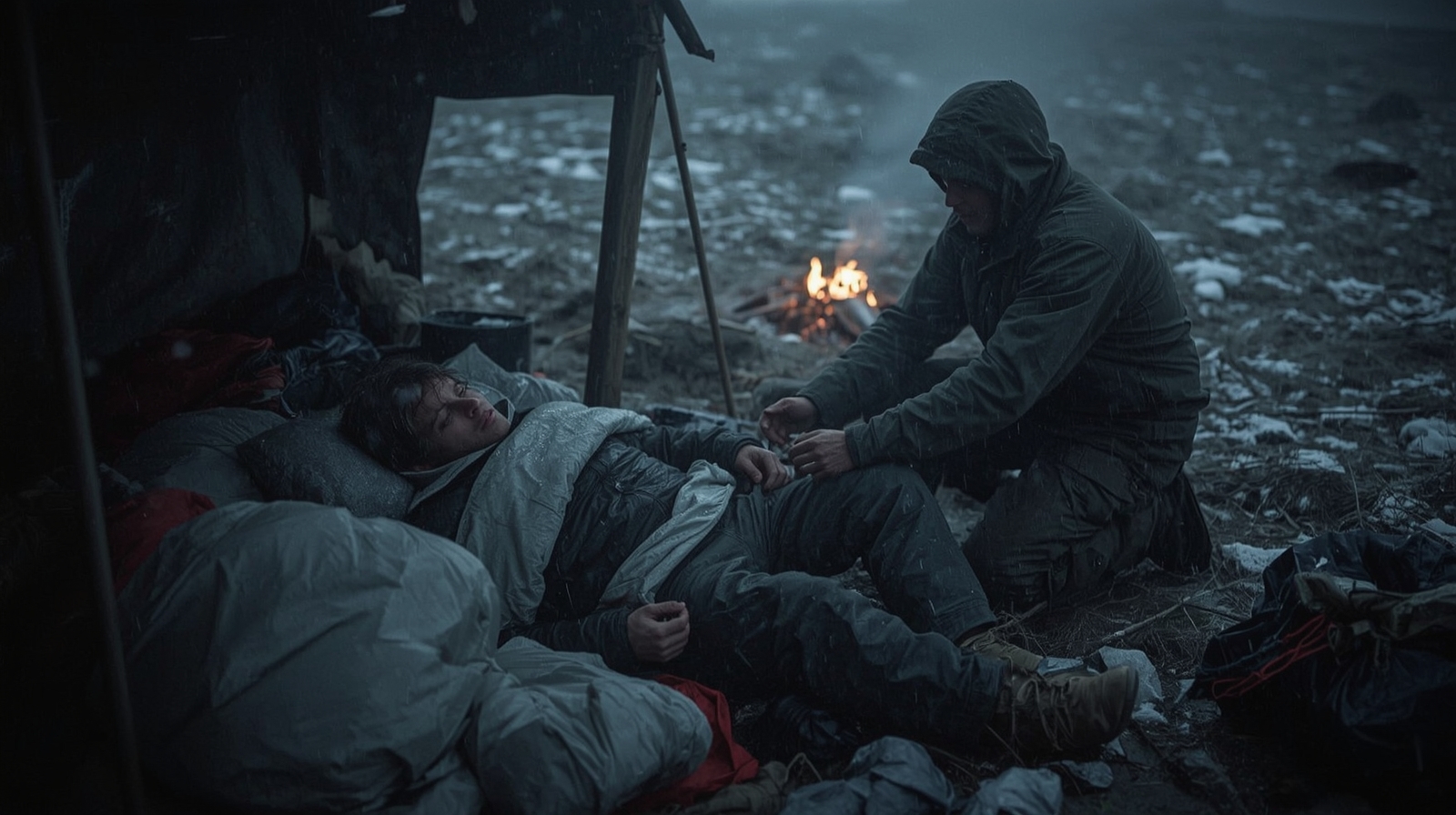
Hypothermia is a performance failure, not a temperature number
What hypothermia really is in the field
Hypothermia starts when your core temperature drops low enough that your body can’t keep up with heat loss. In the real world you often won’t have a thermometer. Even if you did, you don’t get the luxury of waiting for a “medical” number before you act.
Related Articles:
Treat hypothermia like a systems failure. Your insulation is compromised, heat production is falling, and decision-making starts degrading. Once judgment slips, everything else gets harder.
The key idea is that hypothermia can begin while you’re still walking and talking. If you’re wet, underfed, and exposed to wind, you can be sliding toward trouble while still “functioning.” The earlier you intervene, the simpler the fix.
For an authoritative overview of cold injury basics and prevention, review the CDC’s guidance on hypothermia prevention and recognition.
The four ways you lose heat (and which one is killing you today)
You lose heat through:
- Conduction (into the ground or cold objects)
- Convection (wind stripping warm air off your body)
- Radiation (heat leaving you in still air)
- Evaporation (sweat or wet clothing pulling heat as it dries)
In the field, conduction and convection are usually the big two. Evaporation does quiet damage after movement, especially when you stop.
If you sit on cold rock, your insulation under you compresses and stops working. If you stand around in wind during a “quick break,” convection can dump heat fast even if the air temperature doesn’t feel extreme. If you keep hiking in damp layers, evaporation keeps pulling heat until your metabolism can’t cover the bill.
Wind chill is not trivia, it’s your planning factor
Wind chill doesn’t “change the thermometer,” but it absolutely changes how fast you lose heat. It affects route planning, rest-stop discipline, and whether your warm-up plan is realistic.
A calm 30°F day is a different mission than 30°F with steady wind on a ridge. If you plan your clothing and pace for the first one, the second can overwhelm you.
Use the National Weather Service chart as a planning tool, especially when you’re deciding whether an exposed ridgeline is worth it: NWS wind chill chart.
Common hypothermia setups you should plan against
You can prevent a lot of cold injuries by recognizing the “usual suspects” that set people up to fail. Once you know the patterns, you’ll start seeing them early.
Wet plus wind: the classic failure chain
Most hypothermia incidents are not “Arctic expeditions.” They’re wet-and-windy shoulder-season days where you get soaked and then slow down.
Rain, sleet, creek crossings, or even sweat can load your layers with moisture. Then the wind hits during a stop, your heat production drops, and your temperature starts sliding.
The dangerous part is how normal it feels at first. You’re still moving, still navigating, still thinking you can “push to the next point.” That mindset is how you end up cold and exhausted right when terrain or daylight demands precision.
Fatigue, hunger, and the slow loss of heat production
Your body is a furnace, and it needs fuel. When you’re underfed or depleted, you shiver less effectively and fatigue faster.
That means you move slower. Moving slower means you produce less heat. This spiral is why hypothermia is often paired with poor decisions and route mistakes.
In training environments, I saw the same pattern: strong people get cold when they stop managing small basics. They miss meals, skip water, push a pace, then take a long exposed halt. You prevent a lot of hypothermia by treating calories and tempo like part of your insulation plan.
Terrain traps and camp decisions that amplify cold exposure
Cold air settles. Valleys, creek bottoms, and open saddles can feel like refrigerators even when higher ground is milder.
Bad camp placement also creates unnecessary wind exposure and water pooling. The result is predictable: wet gear, poor sleep, and a cold start the next day.
If you want the field-practical version of “microclimate,” start with smart placement and layout. The difference between a sheltered site and a wind tunnel can be the difference between sleeping and shivering all night. Use this as a baseline: shelter site selection and camp layout.
Early recognition: catching it before it catches you
Once hypothermia gets momentum, you spend more time and gear getting back to baseline. The win is catching it early, when simple fixes still work.
The early signs are behavioral before they are dramatic
In mild hypothermia, you’ll usually see a change in performance before you see a collapse. The person gets quieter, clumsier, or “argumentative” about simple tasks.
They may insist they’re fine while they visibly fumble buckles, drop gear, or mismanage zippers. That mismatch matters.
Watch for the classic pattern: cold skin, persistent shivering, and subtle confusion. In a team, treat a sudden drop in competence as a medical problem until proven otherwise. In solo travel, treat it as a safety trigger to stop and correct the heat-loss problem immediately.
Quick field checks you can run without equipment
You need simple checks that work under stress. Run a short sequence:
- Ask them to state the plan: where you are, where you’re going, and the next action.
- Have them do a fine-motor task: clip a buckle, tie a basic knot, or operate a zipper with gloves on.
If the plan is vague and the hands can’t work, you’re behind the curve. Don’t debate it. Intervene.
Another reliable indicator is shivering quality. Strong, continuous shivering usually points to mild-to-moderate cold stress. Shivering that weakens or stops in a cold person who is not warming up is a red flag, not a sign of improvement.
Don’t miss the “I’m just tired” camouflage
People often report fatigue, irritability, and “just wanting to sit for a minute.” That’s the moment to get proactive.
If you allow an exhausted, damp person to sit in wind, you’re effectively ordering them to cool down. It happens fast.
Set a hard standard: breaks are short, sheltered, and deliberate. If someone needs a long stop, treat it like a warming stop with insulation, wind protection, and calories. This is discipline, not drama.
Staging hypothermia: what changes as it gets worse
Staging isn’t about sounding clinical. It’s about choosing actions that won’t backfire, especially when the casualty is getting weaker.
Mild, moderate, severe: practical differences you can act on
Staging matters because your priorities change. Mild hypothermia is often fixable with simple shelter, dry layers, and calories.
Moderate hypothermia is when coordination and judgment are degraded enough that self-rescue becomes unreliable. Severe hypothermia is a medical emergency where rough handling and aggressive rewarming mistakes can kill.
Use observable signs, not guesswork. Don’t get trapped in debates about exact temperatures. Your job is to recognize the stage and apply the safest, highest-payoff actions.
A simple staging table for quick decisions
| Stage | Typical signs you can observe | What you prioritize right now | What to avoid |
|---|---|---|---|
| Mild | Alert, shivering, clumsy, cold stress complaints | Stop heat loss, add insulation, warm sweet drinks if alert | Long exposed breaks, “sweat it out” movement |
| Moderate | Confusion, slurred speech, stumbling, shivering may be intense or irregular | Gentle handling, hypowrap, active external heat to trunk, evacuation planning | Forcing hard exercise, hot shower/immersion, rough transport |
| Severe | Altered consciousness, very weak/absent shivering, may appear “sleepy” | Handle like fragile, prevent afterdrop, urgent evacuation, monitor airway/breathing | Excessive movement, limb heating first, rapid position changes |
Your decision point: can they self-manage or not?
A useful operational question is: can the person manage their own layers, hydration, and navigation without prompting?
If the answer is no, treat it as at least moderate hypothermia. That means you stop gambling on “we’ll be fine in an hour” and start building a stable warming and evacuation plan.
This is also where ego gets dangerous. Hypothermia doesn’t care how tough you are. It punishes poor thermal management and delayed action.
Afterdrop and rescue collapse: why warming can look like it made things worse
This is the part many people get wrong: not all warming is equal, and not all movement is safe. The casualty can worsen even while you’re “helping” if you do it the wrong way.
Afterdrop explained without the medical jargon
Afterdrop is a continued decline in core temperature after rescue or rewarming begins. The simplest way to think of it is this: your limbs and skin are cold, your core is warmer, and when you start moving blood around (or apply heat wrong), you can send colder blood back to the core.
It’s not a myth. It’s one reason field hypothermia care emphasizes gentle handling and trunk-first warming.
You can do everything with good intentions and still trigger a worsening if you warm or move the casualty aggressively. For a credible overview of cold exposure risks and prevention messaging from federal land management, see the National Park Service guidance: NPS cold weather safety.
Rescue collapse: the “standing up and dropping” problem
Rescue collapse is when a hypothermic person deteriorates rapidly during or after rescue. Sometimes they collapse when they stand or start moving.
In the field, the common mistake is rushing the person into walking “to warm up” when they’re already slipping. Movement does produce heat, but it also changes circulation and can expose them to wind.
If someone is moderate or worse, assume their cardiovascular system is stressed. Keep them horizontal when practical, move them gently, and avoid sudden posture changes. If you need to relocate, do it with a controlled pace and a plan.
Why trunk-first warming and gentle handling are priorities
Trunk-first warming protects the core: chest, back, armpits, and groin zones. Warming limbs aggressively can dilate blood vessels and drive cold blood back toward the heart.
That can worsen core temperature and provoke arrhythmias in severe cases. Your goal is to slow heat loss, add insulation, and apply controlled heat to the trunk while you prepare evacuation or continued sheltering.
Think: stabilize first, then improve.
Rewarming priorities that work with limited gear
Now that you understand the risks, you can set priorities that consistently work in bad weather and with imperfect equipment.
Stop the bleeding: break the heat-loss pathways
Rewarming fails if heat loss continues. Handle the basics in a hard order:
- Get the person out of wind.
- Get them off the ground.
- Remove wet layers and replace with dry insulation, or create a vapor barrier to stop evaporative loss.
- Protect the head and neck, and seal drafts.
If you do nothing else, do those things. A lot of “rewarming” is simply preventing further cooling.
Quick rewarming priorities (order matters) 1) Wind and ground protection 2) Wet off, dry on (or vapor barrier) 3) Insulation wrap with minimal air gaps 4) Trunk heat (controlled) 5) Calories and warm fluids if alert
Passive versus active rewarming (and when each makes sense)
Passive rewarming means you let the body warm itself by stopping heat loss and providing insulation. This is appropriate for mild hypothermia in an alert person who is still shivering strongly.
It is often the safest approach when you don’t have reliable heat sources. It’s also easier to sustain over hours.
Active external rewarming adds heat from outside: warm water bottles, heat packs, warmed rocks (used carefully), or body-heat sharing. This becomes more important in moderate hypothermia, where the casualty may not generate enough heat on their own.
Internal rewarming: calories and warm drinks as a tool
If the person is awake, coherent, and able to swallow, warm sweet fluids are a high-value move. Sugar supports shivering thermogenesis, and warmth supports comfort and core temperature.
Think warm water with sugar, broth, or a warm sports drink. Keep it simple and repeatable.
Avoid alcohol. It can increase heat loss by dilating blood vessels, and it degrades judgment when you need it most. Also be cautious with caffeine if the person is significantly cold and stressed.
Improvised warming techniques you can build fast
When you don’t have perfect gear, you win with good structure: insulation, sealing, and controlled heat application.
The hypothermia wrap (hypowrap) that actually performs
A good hypowrap is about layering and sealing. Start with a ground barrier (foam pad, pack, pine bough bed, even a rope-lashed platform if you must).
Add dry insulation around the casualty: sleeping bag, extra jackets, spare clothing, or a quilted liner. Fill dead space, especially around shoulders and hips.
Then add a vapor barrier layer to trap warm air and stop evaporation: a bivy sack, tarp, contractor bag, or even a poncho. Seal openings at the neck and feet as best you can without restricting breathing. The goal is to create a stable microclimate that your heat sources can actually improve.
Warm water bottles, heat packs, and safe placement
Warm water bottles are one of the best field-expedient heaters because they are controllable and long-lasting. Use durable bottles and warm (not boiling) water to avoid burns.
Place them against the trunk:
- Armpits
- Chest sides
- Groin area
- Along the back (if you can place without rolling them roughly)
Chemical heat packs work too, but they can cause burns, especially on cold skin with reduced sensation. Wrap them in cloth, check skin frequently, and keep them on the trunk.
Do not “ring” the hands and feet with heat packs first if the person is moderate to severe. That’s how you set up afterdrop problems.
Buddy warming: effective, but you need boundaries
Body heat sharing can be life-saving when you lack gear, but it needs discipline. If you do it, put at least one dry layer between skin and skin to reduce sweat and keep it tolerable.
Focus contact on the trunk areas, not just hands and feet. The goal is core stability, not temporary comfort.
Also manage the rest of the team. If you sacrifice your own insulation and become the second casualty, you just doubled the problem. Rotate if needed, and keep the warming system stable rather than frantic.
Shelter and fire integration:
Once your casualty is insulated, your next job is to control the environment around them. This is where small shelter decisions and smart fire placement can change the outcome.
Start by thinking in two tracks: wind control and ground insulation. If you don’t address those, your fire becomes a morale booster instead of a warming tool.
A practical approach is to build a windbreak first, then add fire support if conditions allow it. If precipitation is ongoing, you also need a plan to keep fuel usable.
Key moves that work with minimal gear:
- Block wind with a tarp, poncho, brush wall, or packs placed upwind.
- Improve ground insulation with pads, packs, or a thick debris layer under the casualty.
- Use fire to warm people and water, not to “blast heat” directly onto cold skin.
- Stage a drying line near (not over) the heat source so you can cycle damp layers.
If you’re operating in wet conditions, fire becomes a skill problem, not a luck problem. For a deeper dive on keeping fire reliable in rain and snow, use this reference: All-Weather Firecraft: Processing Wet Wood, Reliable Fire Lays in Rain/Snow, and Keeping Coals Alive Overnight.
Finally, keep the scene controlled. A chaotic fire site with people moving constantly, opening the shelter, and stripping layers at random can undo your warming progress. Assign tasks, keep movement minimal, and protect the casualty’s heat bubble.