Cold-Weather Stove and Fuel Management: Canister Performance, Liquid-Fuel Priming, Safe Windscreens, and Snow-Melting Efficiency
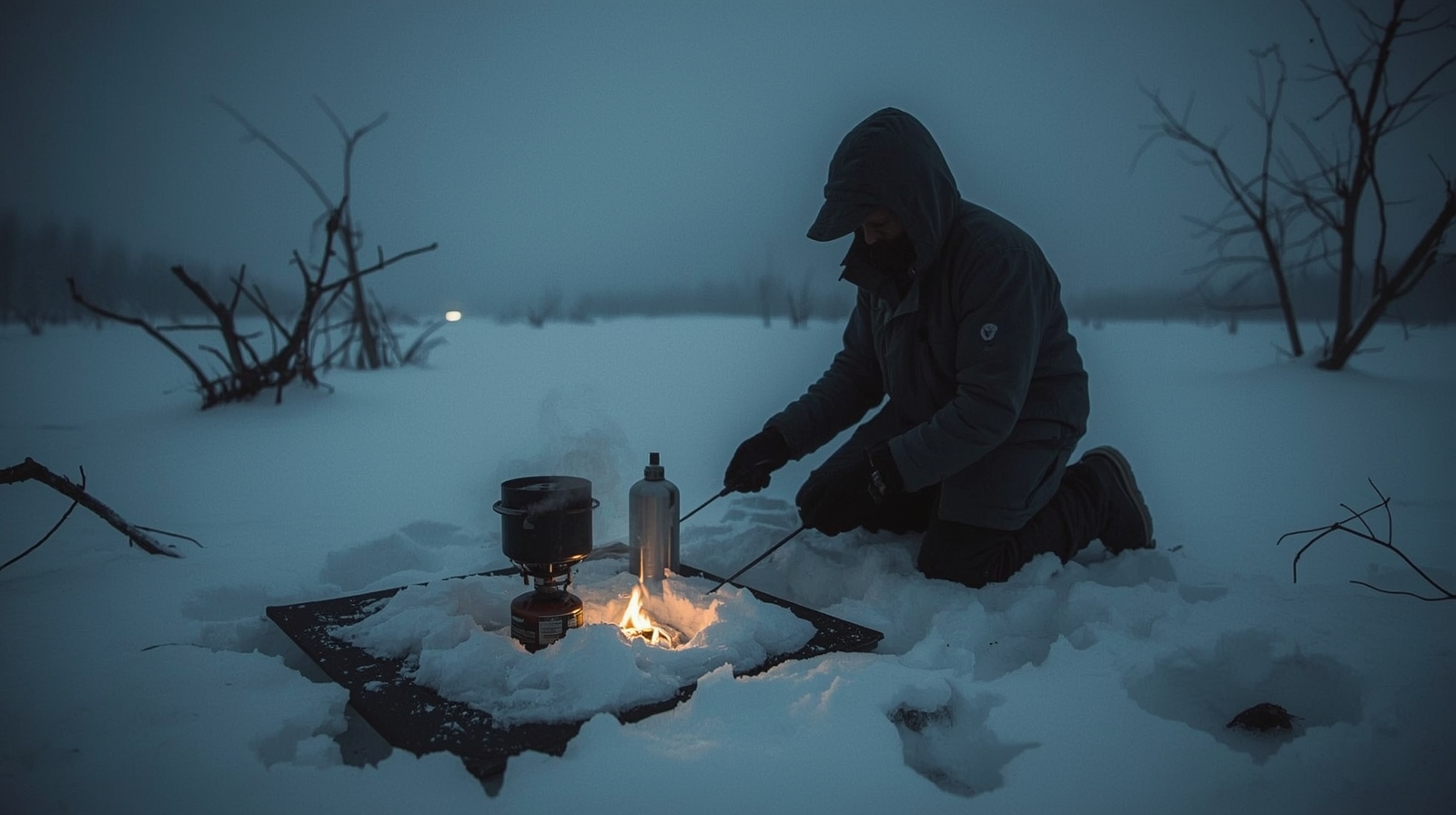
Cold changes everything: pressure, flame behavior, and your margin for error
Winter cooking is less about recipes and more about systems. In the cold, your stove is fighting physics: lower vapor pressure, thicker fuels, colder metal, and wind that strips heat away faster than you can replace it. If you treat a winter boil like a summer boil, you’ll waste fuel and time.
The other piece people miss is consequence. In warm weather, a sputtering stove is an inconvenience. In winter, it can become a hydration problem, a morale problem, and in a worst-case scenario, a safety problem.
That’s why the military mindset of plan for failure, build redundancy translates well here. Your stove plan should assume wind, cold-soak, and at least one minor equipment hiccup.
Why vapor pressure is the hidden limiter on canister stoves
Canister stoves depend on fuel vapor pressure to push gas to the burner. As temperature drops, vapor pressure drops with it. The stove loses output even if the canister is half full.
The effect is not subtle below freezing. It also gets worse as the canister empties because the remaining fuel blend shifts, and the canister can’t self-pressurize as efficiently.
A simple way to think about it: your canister is a self-pressurizing tank. In the cold, it can’t build pressure fast enough, so the flame goes weak and inefficient.
You can sometimes limp along by warming the canister, but you can’t cheat physics forever. That’s why winter systems often shift toward remote canister stoves that can run inverted (liquid feed) or toward true liquid-fuel stoves.
Cold-soak and wind chill: the difference between air temperature and stove temperature
Air temperature is only part of the story. If your stove and fuel have been sitting in snow for hours, they’re cold-soaked. Add wind and you get aggressive convective heat loss that acts like a performance tax on everything-your hands, your pot, and your burner.
This is also why “it was 20°F, so my canister should’ve been fine” doesn’t always hold up. Your setup may be operating colder than ambient because it’s sitting on a cold platform while wind pulls heat away.
The National Weather Service wind chill resources are a good reminder of how quickly moving air increases heat loss: NWS Wind Chill Chart.
With that foundation, you can start making smart stove choices instead of guessing.
Canister stove performance in subfreezing temperatures
Canister systems can work in the cold, but you need to understand the limits and manage them intentionally. The key is matching your stove style and your fuel blend to expected temperatures, then using safe, controlled warming techniques.
If you’re running a lightweight top-mount stove in winter, you’re choosing simplicity over cold reliability. That can be a fine trade for shoulder season trips. You just need to know where the cliff edge is.
Fuel blends, isobutane vs propane, and what “four-season” really means
Most backpacking canisters are blends of isobutane and propane (sometimes with n-butane). Propane performs better in the cold, but it must be stored under higher pressure. That’s why it’s blended rather than used alone in typical backpacking canisters.
Here’s the practical takeaway: a “winter blend” canister buys you time, not immunity. Expect canister stoves to start struggling as temperatures dip below freezing. Also expect a noticeable drop-off when the canister is partially empty.
If you’re planning for sustained teens (°F) or lower, build your plan around either:
- an inverted-capable remote canister stove, or
- a liquid-fuel stove.
Safe ways to warm a canister without turning it into a hazard
Warming a canister is about gentle heat, not improvising a flamethrower. Never apply open flame to the canister, and never fully enclose it with a windscreen that traps heat.
Safer options that work in the real world:
- Keep the canister inside your jacket (inside an insulation layer) for 10-15 minutes before cooking.
- Sleep with the canister near your feet if overnight temperatures are low.
- Insulate the canister from snow with a foam pad or a small wood board.
- Use a shallow water bath only if you can keep the water from freezing and you can monitor it constantly.
Quick reference: If your canister feels cold enough that you don’t want it against bare skin, it’s cold enough to underperform. Warm it with body heat and insulation, not fire.
Once you’ve got canister basics down, the next upgrade is learning when (and how) to run a remote canister stove in liquid-feed mode.
Remote canister stoves, inverted running, and managing liquid feed
If you want canister convenience but need winter performance, remote canister stoves are the bridge. The differentiator is whether the stove is designed to run with the canister inverted (liquid feed) and whether it has a preheat tube to vaporize fuel before combustion.
This is where many people accidentally create a dangerous setup. They add an aggressive windscreen, crank the stove, and then wonder why the canister is getting hot.
Remote canister stoves can be safer in wind because you can shield the burner more effectively while keeping the canister outside the heat zone.
When inverted canister mode is the right call
Inverted canister mode is useful when vapor pressure is the bottleneck. By feeding liquid fuel to the stove and vaporizing it in a preheat tube, you reduce reliance on canister vapor pressure. You’ll see steadier flames in colder temperatures and more consistent output as the canister empties.
That said, inverted mode isn’t “set and forget.” In most systems, you start upright until the stove warms the generator/preheat tube, then invert.
If you invert too early, you can get flare-ups or sputtering. Practice this at home with gloves on so you don’t learn it the hard way when your hands are numb.
Avoiding flare-ups and keeping the generator tube doing its job
Liquid-feed operation demands heat at the generator tube. Wind can rob that heat and cause incomplete vaporization, which shows up as yellow flames, soot, and instability.
Your wind protection should focus on the burner area without wrapping heat around the canister. A solid field rhythm looks like this:
- Build a stable, insulated stove platform.
- Light the stove upright on a low-to-medium setting.
- Let it run 30-60 seconds to warm the generator tube.
- Invert the canister if the stove is designed for it.
- Re-check canister temperature with your hand frequently.
If you want a deeper winter shelter approach that complements safe cooking, review snow shelters that don’t collapse. Where you cook matters as much as what you cook on.
If canister systems feel borderline for your temperatures, that’s usually the cue to move to liquid fuel.
Liquid-fuel stoves in winter: reliability, maintenance, and fuel choices
Liquid-fuel stoves (white gas, kerosene, sometimes diesel/jet fuel) are the traditional answer for serious cold. They don’t rely on vapor pressure the same way canisters do, and they can deliver high heat for snow melting.
The tradeoff is complexity. You’re managing pumps, seals, jets, and priming.
The good news is that once you build a checklist-driven habit, liquid fuel becomes very predictable.
White gas vs kerosene: cold performance and real-world handling
White gas (naphtha) is easier to light and prime cleanly. It’s the common choice for backpackers because it starts well and burns hot.
Kerosene is often cheaper and safer to store (higher flash point), but it can be harder to prime. It also tends to soot more if you rush the preheat.
In practical terms:
- Choose white gas for most cold-weather backpacking.
- Choose kerosene when you need fuel availability or you’re running a stove optimized for it.
Either way, carry a small maintenance kit:
- spare O-rings
- jet pricker/cleaning needle
- pump cup lube
- a small rag
If you can keep your feet healthy with a system, you can keep your stove running with one too-same mindset as foot care for long rucks and multi-day hikes.
Pump pressure and cold-thickened fuel: what to do when output drops
In the cold, seals stiffen and fuel viscosity increases. If your flame is weak, don’t assume the stove is “broken.” Work the problem in order.
- Re-pressurize the bottle (more pumps).
- Check that the pump cup is lubricated and sealing.
- Confirm the fuel line isn’t kinked or packed with ice.
- Clean the jet if the flame is sputtery or asymmetrical.
One military habit that helps: do a quick function check before you need the stove. If you roll into camp late and cold, that’s not the time to discover your pump cup is dry.
Once you commit to liquid fuel, the one skill that makes or breaks your experience is priming.
Liquid-fuel priming that’s controlled, clean, and low-drama
Priming is where most winter stove anxiety comes from. It looks aggressive, it can flare, and it feels like you’re doing something wrong even when you’re doing it right.
The goal is simple: preheat the generator so liquid fuel vaporizes cleanly when you open the valve.
Priming also ties directly to safety. A sloppy prime wastes fuel, produces soot, and increases the chance of knocking something over when you react to a flare.
A step-by-step priming sequence you can repeat with gloves on
Use a consistent routine so you don’t improvise when you’re tired.
Checklist for controlled priming:
- Set the stove on a stable, insulated platform (foam + flat base).
- Clear combustibles and keep the fuel bottle positioned safely.
- Close the control valve fully.
- Pressurize the bottle.
- Add a small prime charge (follow your stove’s method).
- Ignite the prime flame and wait for it to burn down.
- When the prime flame is nearly out, crack the valve slowly.
- Adjust to a steady blue flame, then increase output.
If you open the valve too early, you’ll dump raw fuel into a not-yet-hot generator. That’s the classic flare-up.
Keep your movements calm and deliberate. Think of it like weapons handling: smooth is safe.
Priming paste, alcohol preheat, and reducing soot on cold starts
If your stove supports it, priming paste or a small splash of alcohol for preheat can reduce soot compared to priming with white gas. This matters when you’re melting snow day after day; soot builds up, dirties pots, and reduces heat transfer.
Kerosene users especially benefit from a cleaner preheat method. A cleaner prime means less yellow flame and less carbon on your cookware.
It also keeps your hands cleaner, which isn’t a small thing when you’re managing gloves, zippers, and hydration in freezing temperatures.
Once priming is squared away, wind protection becomes your biggest fuel saver-if you do it safely.
Windscreens and cold-weather stove safety: blocking wind without overheating fuel
Wind protection is one of the highest-return skills you can build. Even a modest breeze can double boil times and burn through your fuel plan.
But winter wind protection has a hard boundary: you can’t trap heat around a canister.
This is where people accidentally create the perfect storm: windscreen + reflector + high output + close canister. That combination can overheat a canister and create a real hazard.
Safe windscreen setup for canister stoves (what not to do)
For top-mount canister stoves, avoid wraparound windscreens that enclose the canister. Heat rising off the burner can reflect back down, and the canister can warm far beyond what you feel at the flame.
Safer alternatives:
- Use a partial windscreen that blocks wind from one direction only.
- Use natural windbreaks (packs, snow walls) placed at a safe distance.
- Prefer remote canister stoves if you need full windscreens.
As a rule: if you can’t keep your hand on the canister comfortably, shut it down and reconfigure.
For broader storm camping systems that manage wind without creating new hazards, see tarp shelter systems for wind and heavy rain.
Windscreens for liquid-fuel stoves: bigger gains, different risks
Liquid-fuel stoves generally tolerate more aggressive windscreens because the fuel bottle can be positioned away from the burner. This lets you capture heat more efficiently, which is exactly what you want for snow melting.
Still, don’t get careless. Windscreens can concentrate heat onto the stove’s pump area or fuel line if your layout is sloppy.
Keep the bottle outside the windscreen. Route the fuel line so it isn’t pressed against hot metal. In deep cold, small mistakes compound fast.
With wind managed, you can finally focus on the thing that consumes most winter fuel: making water.
Snow-melting efficiency: turning fuel into water with less waste
Melting snow is a fuel management problem. You’re paying an energy cost to change ice to liquid, and then often to raise that water to a usable temperature.
If you don’t run a tight process, you’ll burn through your fuel and still end up rationing water. The win is not just a hotter stove. The win is less heat loss and a smarter sequence.
The best process for melting snow without scorching your pot
Start with a small amount of liquid water in the pot. This protects your pot, improves heat transfer, and prevents a thin “snow dome” from insulating itself against the pot walls.
A simple, repeatable snow-melting workflow:
- Add a small amount of water to the pot (even a few ounces helps).
- Add snow gradually. Pack it in lightly; don’t overfill.
- Stir as it collapses, then add more snow.
- Keep the lid on whenever you’re not actively stirring.
- Once you have liquid water, bring it to your target temperature (warm for drinking, hot for meals).
Two quick cautions that save fuel:
- Avoid fluffy, low-density snow when you can. Denser snow yields more water per pot.
- Don’t run a roaring flame that wraps around the pot sides. If flames are licking past the pot, you’re heating the air.
If you’re relying on snow for all water, treat it like any other critical system. Build time into your routine, because rushing tends to waste fuel.